


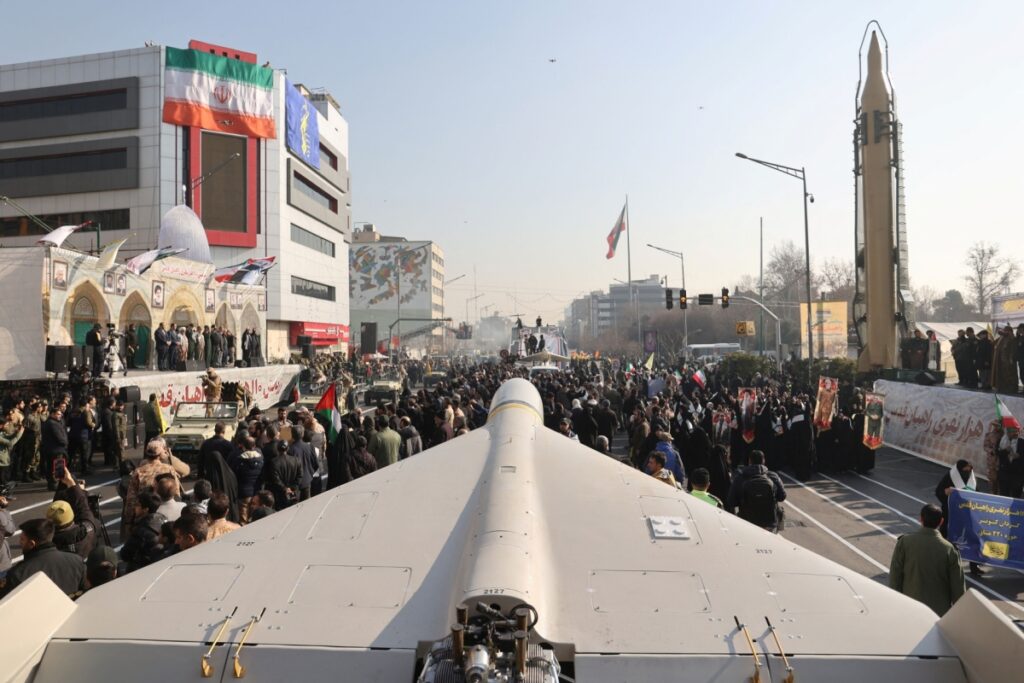
The conflict between Israel and Iran has entered a far more dangerous phase.
Following US-Israeli airstrikes that killed Iran’s Supreme Leader, Ali Khamenei, Israel has now launched a renewed wave of attacks targeting sites “in the heart of Tehran.” Iranian officials have called the killing a direct escalation and warned that the United States crossed what they described as “a very dangerous red line.”
In response to Khamenei’s death, Tehran has established a temporary leadership council to oversee state affairs. The move signals an attempt to stabilize internal power structures while preparing for broader retaliation.
Iran Responds With Regional Strikes
Iran has already retaliated.
Missile and drone attacks have targeted Israeli territory, US military bases, and additional strategic locations across the region. One Iranian missile struck a residential building near Jerusalem, killing at least eight people. Several others were injured as emergency crews searched through debris.
The escalation has also affected civilian infrastructure. Major air hubs have suffered damage, densely populated neighborhoods have been shaken by explosions, and regional oil shipments have been disrupted raising concerns in global energy markets.
This is no longer a limited exchange. It is a widening confrontation with regional consequences.
Political Shockwaves Inside Iran
Inside Iran, the reaction has been sharply divided.
State supporters mourn the death of the Supreme Leader, calling it an act of foreign aggression. At the same time, scattered reports indicate that some segments of the population view the moment as a turning point in the country’s political trajectory.
The formation of a leadership council suggests that Iranian authorities are focused on preventing instability at the top while maintaining command over military operations.
The coming days will be critical. Leadership transitions in the middle of active conflict carry unpredictable risks.
Reactions Across the United States
In the United States, public reaction has been mixed.
Some Americans gathered in support of the strikes, framing them as a necessary response to Iran’s actions in the region. Others protested, warning that the escalation could draw the US into a prolonged war.
The divide reflects broader concerns about the long-term consequences of regime-level targeting and regional military expansion.
What Happens Next?
The central question now is scale.
Will this remain a contained confrontation between Israel and Iran with limited US involvement? Or will it expand into a broader regional conflict drawing in additional powers?
With airspace disruptions, damaged infrastructure, and rising casualties, the situation is volatile. Oil markets are already reacting. Diplomatic channels appear strained.
This is no longer just another flare-up in a long-running rivalry. The death of Iran’s Supreme Leader marks a historic rupture — and what follows could redefine power dynamics across the Middle East.
The world is watching closely.